
IGNOU PGDRD Project (MRDP-205): Complete Guide to Topics, Synopsis, Format & Submission

The IGNOU PGDRD Project is the single most important academic requirement for students enrolled in the Post Graduate Diploma in Rural Development (PGDRD) programme. Yet, it is also the most misunderstood part of the course.
Students regularly search for answers to questions like:
How to prepare the IGNOU PGDRD project report?
What is MRDP-205 project work?
Is the PGDRD project compulsory?
How to get IGNOU PGDRD project synopsis approved?
If you’re confused, that’s completely normal.
IGNOU follows a distance-learning model. Because of this, students do not always receive step-by-step guidance for project work. As a result, many learners delay their project, submit incorrect reports, or face rejection simply due to lack of clarity.
This guide is designed to change that.
In this complete series, you’ll learn exactly how the IGNOU PGDRD Project works, starting from the basics and moving step by step through the entire process.
This is PART 1 of the guide. It focuses on:
- What the IGNOU PGDRD Project is
- What MRDP-205 means
- Why the project is compulsory
- Who must submit it
- When you should start
- How the overall project lifecycle works
Let’s begin at the foundation.
Also, you may like to get IGNOU PGDRD solved assignment.
What Is the IGNOU PGDRD Project?
The IGNOU PGDRD Project is a compulsory project work component of the Post Graduate Diploma in Rural Development programme offered by Indira Gandhi National Open University.
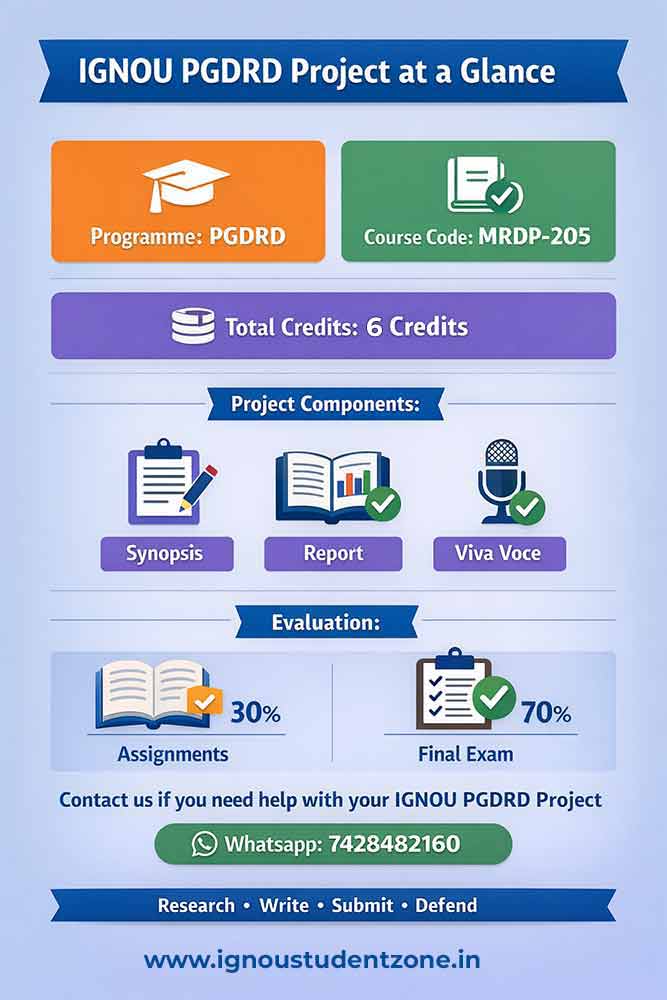
The official course code for the project is MRDP-205.
Earlier, IGNOU used the course code RDD-5 for PGDRD project work. However, after syllabus revision, the university replaced it with MRDP-205. If you are enrolled under the current PGDRD structure, MRDP-205 is the only valid project course.
This project is not optional.
Every PGDRD student must:
- Prepare a project synopsis (proposal)
- Get the synopsis approved
- Conduct research (field-based or secondary)
- Write a detailed project report
- Submit the project within the deadline
Until MRDP-205 is successfully completed, your PGDRD programme is considered incomplete, even if all theory exams are cleared.
What Does MRDP-205 Mean in PGDRD?
MRDP-205 stands for Project Work in Rural Development.
It carries 6 credits, which makes it one of the highest-weight components of the PGDRD programme. IGNOU designed MRDP-205 to ensure that students do more than just study rural development concepts theoretically.
Through this project, learners are expected to:
- Identify real rural development issues
- Apply concepts learned in theory courses
- Understand grassroots-level challenges
- Use research tools and methods
- Analyse data and draw practical conclusions
In short, MRDP-205 transforms you from a learner into a research-oriented practitioner in rural development.
Why the IGNOU PGDRD Project Is Mandatory
Many students ask an important question:
“If I pass all theory exams, why is the project still required?”
The answer lies in IGNOU’s academic philosophy.
The PGDRD programme is meant to prepare students for real-world rural development work. Theory alone cannot achieve that. IGNOU uses the project to evaluate whether a student can:
- Understand rural realities
- Conduct basic research
- Interpret development programmes
- Suggest workable recommendations
Because of this, IGNOU clearly states that:
- Passing theory exams alone is not enough
- Assignment marks and project marks both matter
- The diploma is awarded only after project completion
If the IGNOU PGDRD Project is not submitted or not approved:
- Your grade card remains incomplete
- Your programme completion is delayed
- Your PGDRD certificate is not issued
This is why MRDP-205 must be treated as seriously as any theory paper.
Related Article: Download IGNOU PGDRD study material
Medium of Writing for IGNOU PGDRD Project
The PGDRD programme is offered in English medium and Hindi medium.
Your IGNOU PGDRD Project must be written strictly in the same medium you selected during admission.
This applies to:
- Project synopsis
- Final project report
- Annexures and questionnaires
English-medium students must submit the project in English.
Hindi-medium students must submit the project in Hindi.
IGNOU does not allow students to:
- Mix languages
- Translate reports at the last stage
- Change the medium during project submission
Choosing the correct medium from the beginning avoids unnecessary rejection or delays.
Who Must Submit the IGNOU PGDRD Project?
The IGNOU PGDRD Project is compulsory for all students enrolled in PGDRD, regardless of:
- Admission session (January or July)
- Study centre
- Employment status
- Academic background
Whether you are:
- A working professional
- A fresh graduate
- A government employee
- A field worker in rural development
You must complete MRDP-205 to finish the PGDRD programme.
There are no exemptions.
When Should You Start the IGNOU PGDRD Project?
One of the most common mistakes students make is starting the project too late.
Ideally, you should begin planning your IGNOU PGDRD Project when:
- You have completed most core PGDRD theory courses
- You understand basic rural development concepts
- You are familiar with research methodology
Starting early helps you:
- Choose a better topic
- Avoid rushed fieldwork
- Improve synopsis quality
- Reduce rejection risk
- Submit on time without stress
Waiting until the last submission month often leads to poor-quality work and avoidable errors.
The Complete Lifecycle of IGNOU PGDRD Project (MRDP-205)
Understanding the project lifecycle is critical.
The IGNOU PGDRD Project follows a clear academic sequence. Skipping steps or changing the order can lead to rejection.
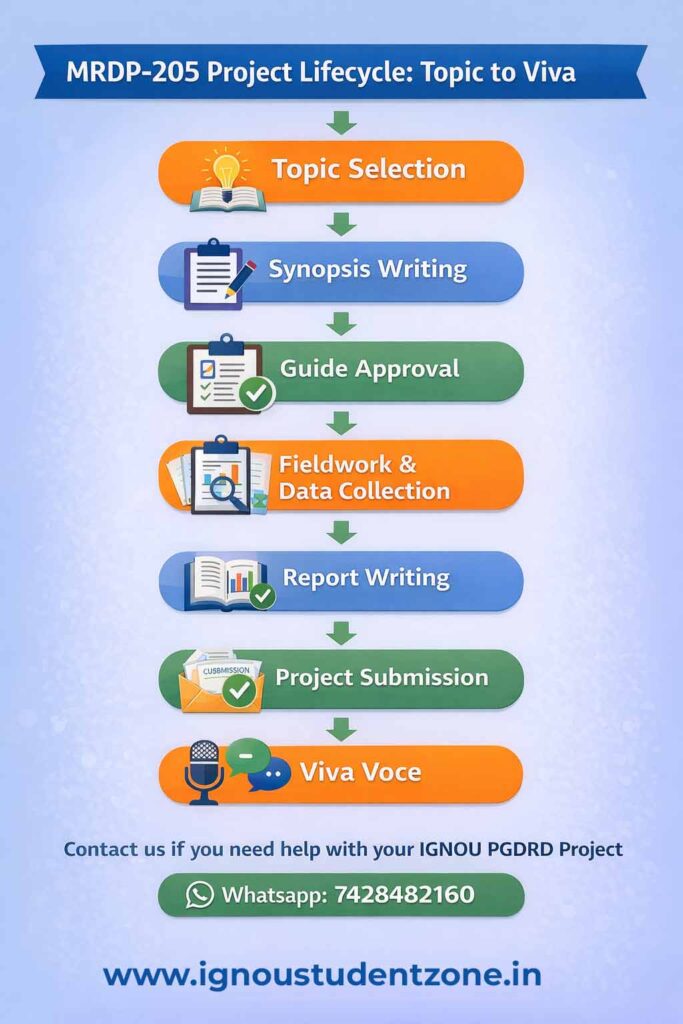
The standard lifecycle looks like this:
First, you understand the official project guidelines issued by IGNOU.
Next, you select a suitable rural development topic.
Then, you identify and finalize an eligible project guide.
After that, you prepare the project synopsis.
The synopsis is submitted for approval.
Once approved, you begin data collection and research.
Then, you write the final project report.
Finally, you submit the project within the deadline.
Some students may also be called for a viva voce, depending on IGNOU’s evaluation policy for that session.
Each stage builds on the previous one. That’s why clarity at the beginning saves months later.
Choosing the Right Topic for IGNOU PGDRD Project (MRDP-205)
Topic selection is the single most important decision you will make in the IGNOU PGDRD Project. A well-chosen topic makes the rest of the project smooth. A poorly chosen topic can lead to synopsis rejection, weak research, or even project failure.
IGNOU does not evaluate projects only on writing quality. It evaluates whether your topic:
- Fits the PGDRD programme objectives
- Is relevant to rural development
- Is feasible within time and resources
- Allows meaningful analysis
That’s why choosing the right MRDP-205 project topic is not about picking something that “sounds good.” It’s about choosing something that can actually be studied.
What Makes a PGDRD Project Topic Approachable and Approvable
Before finalising any topic, ask yourself these questions.
Can I clearly define the problem?
Can I collect data for this topic?
Is this topic linked to rural development practice?
Can this be completed within one academic cycle?
If the answer to any of these is “no,” rethink the topic.
IGNOU prefers topics that are:
- Specific rather than broad
- Field-oriented or policy-oriented
- Localised to a region, block, or group
- Aligned with rural development schemes or institutions
For example, “Rural Development in India” is too broad.
But “Impact of MGNREGA on Livelihood Security in XYZ Block” is specific and workable.
Common Mistakes Students Make While Selecting PGDRD Project Topics
Many synopsis rejections happen at the topic stage itself. The most common mistakes include:
Choosing topics that are too wide to handle within limited time
Selecting controversial or politically sensitive topics
Picking topics with no access to data or field area
Copying old project titles without modification
Selecting topics unrelated to rural development
Avoiding these mistakes significantly improves your approval chances.
Popular IGNOU PGDRD Project Topics (MRDP-205)
Below are approved and commonly accepted topic areas, grouped by theme. You can adapt them to your local context.
Rural Poverty and Livelihoods
Impact of MGNREGA on employment generation in rural areas
Role of self-employment programmes in poverty reduction
Livelihood diversification among rural households
Effectiveness of rural credit schemes for small farmers
Women and Social Development
Role of Self-Help Groups in women empowerment
Impact of microfinance on rural women’s income
Participation of women in Panchayati Raj institutions
Gender issues in rural development programmes
Agriculture and Natural Resources
Adoption of sustainable agricultural practices
Impact of irrigation facilities on crop productivity
Awareness of climate change among rural farmers
Role of agricultural extension services
Health, Nutrition, and Sanitation
Access to primary healthcare in rural villages
Role of Anganwadi centres in child nutrition
Impact of Swachh Bharat Abhiyan in rural areas
Maternal health awareness in rural communities
Governance and Institutions
Role of Panchayati Raj institutions in rural development
Functioning of Gram Sabha in local planning
Implementation challenges of rural welfare schemes
Role of NGOs in grassroots development
Education and Migration
School dropout rates in rural areas
Impact of Mid-Day Meal Scheme on attendance
Seasonal migration and rural livelihoods
Skill development programmes for rural youth
Always narrow your topic further by specifying:
- Location
- Time period
- Target group
This improves originality and analytical depth.
How to Finalise Your IGNOU PGDRD Project Topic
Once you shortlist a topic, take these final steps:
Discuss the topic with a project guide
Check availability of data sources
Ensure alignment with PGDRD objectives
Refine the title for clarity and scope
Do not rush this step. A strong topic saves weeks later.
IGNOU PGDRD Project Synopsis (MRDP-205): The Foundation
The synopsis is the blueprint of your entire project.
IGNOU strictly requires synopsis approval before report writing. Any project submitted without prior approval is liable to be rejected.
Think of the synopsis as your research plan presented to IGNOU.
What Is a Synopsis in MRDP-205 Project?
A synopsis explains:
- What you plan to study
- Why the study is important
- How you will conduct the research
- What outcomes you expect
It tells the evaluator that your project is:
- Relevant
- Feasible
- Academically sound
Standard Format of IGNOU PGDRD Project Synopsis
A well-prepared MRDP-205 synopsis generally includes the following sections:
Title of the Study
Introduction and Background
Statement of the Problem
Objectives of the Study
Research Questions or Hypotheses
Review of Literature (brief)
Research Methodology
Sampling Design
Tools for Data Collection
Proposed Chapter Scheme
References
The ideal length is 1,000 to 1,500 words.
Writing Each Section of the PGDRD Synopsis
Title of the Study
The title should be:
- Short
- Specific
- Reflective of the study area
Avoid vague titles. Mention location or target group wherever possible.
Introduction and Problem Statement
This section explains:
- The background of the issue
- Why the problem matters
- Why it needs to be studied
Keep it focused and factual.
Objectives of the Study
Objectives should be:
- Clear
- Measurable
- Limited in number (2–5)
Avoid vague objectives like “to study rural development.”
Research Methodology
This is the most critical section.
You must clearly mention:
- Type of research (descriptive, analytical)
- Source of data (primary/secondary)
- Sampling method and size
- Tools (questionnaire, interview, observation)
Unclear methodology is a common reason for synopsis rejection.
Chapter Scheme
List the proposed chapters in sequence. This shows planning and structure.
How to Get IGNOU PGDRD Synopsis Approved
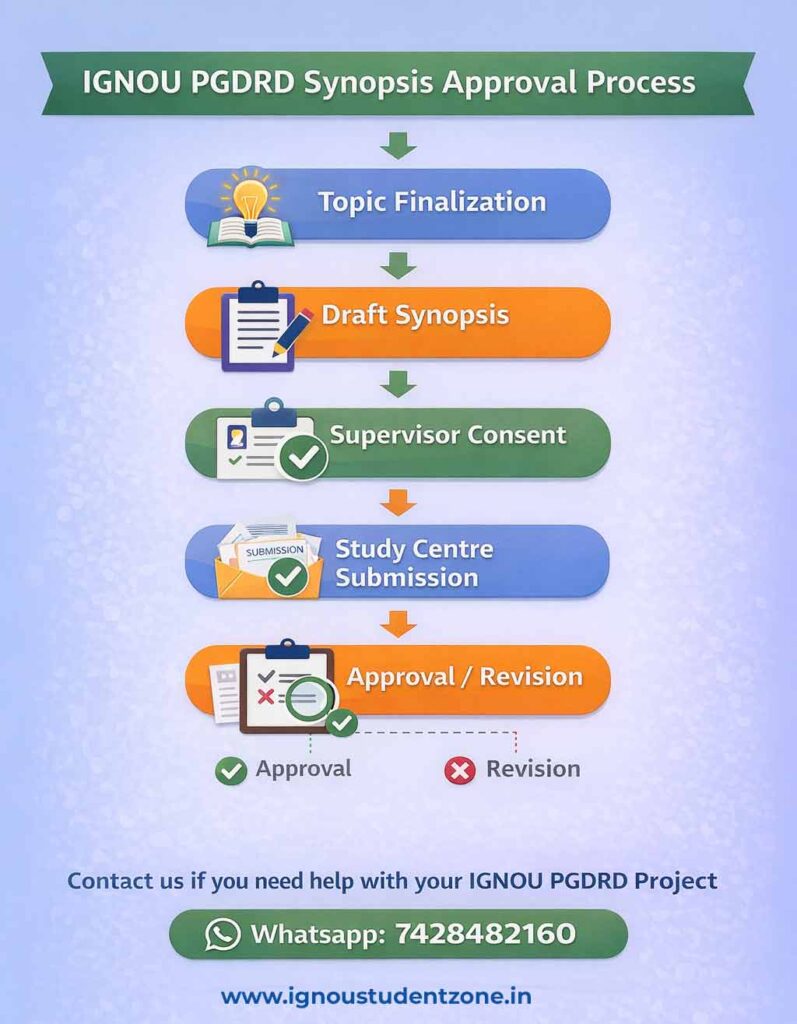
The approval process usually follows these steps:
Finalise topic and synopsis with guide
Attach guide consent letter and bio-data
Submit synopsis as per study centre instructions
Wait for approval confirmation
Only after approval should you proceed with data collection and report writing.
Common Reasons for PGDRD Synopsis Rejection
Understanding rejection reasons helps you avoid them.
The most common causes include:
- Topic outside PGDRD scope
- Weak or unclear objectives
- Poor methodology explanation
- Missing guide documents
- Copy-pasted or generic content
Most rejections are preventable with proper planning.
Practical Tips to Get MRDP-205 Synopsis Approved Faster
Choose a realistic, localised topic
Keep objectives aligned with methodology
Avoid exaggerated claims
Use simple, academic language
Follow IGNOU format strictly
A clean, focused synopsis almost always gets approved.
What Comes Next After Synopsis Approval
Once your synopsis is approved, you can move to:
- Fieldwork and data collection
- Data analysis
- Writing the final project report
Selection of Project Guide for IGNOU PGDRD Project (MRDP-205)
The role of a project guide is critical in the successful completion of the IGNOU PGDRD Project. IGNOU requires every MRDP-205 project to be completed under the supervision of an approved and eligible guide.
A project guide helps you:
- Finalise a suitable topic
- Refine your synopsis
- Choose correct methodology
- Review drafts of the project report
- Ensure compliance with IGNOU guidelines
Selecting an ineligible or unapproved guide is one of the most common reasons for project rejection.
Eligibility Criteria for PGDRD Project Guide
As per IGNOU norms, a project guide should generally:
- Hold a postgraduate degree in Rural Development, Social Work, Sociology, Development Studies, Economics, or a related discipline
- Have teaching, research, or professional experience in the field of rural development
- Be associated with an academic institution, NGO, government department, or development organisation
You must submit:
- Guide’s bio-data
- Consent letter
- Supervisor certificate (signed)
Always confirm guide eligibility before submitting the synopsis.
Writing the IGNOU PGDRD Project Report (MRDP-205)
Once your synopsis is approved, the most important phase begins: writing the final project report.
The IGNOU PGDRD Project Report is not an essay. It is a structured academic document based on research, data, and analysis.
Your report should demonstrate:
- Understanding of rural development concepts
- Application of theory to real situations
- Logical analysis of data
- Practical recommendations
Originality and clarity matter more than complex language.
Chapter-Wise Structure of MRDP-205 Project Report
Although IGNOU does not impose a rigid chapter structure, most approved PGDRD projects follow a standard format.
Chapter 1: Introduction
This chapter introduces:
- Background of the study
- Rationale for selecting the topic
- Scope and limitations
- Structure of the report
It sets the context for the entire project.
Chapter 2: Review of Literature
This chapter reviews:
- Previous studies
- Government reports
- Policies related to your topic
The purpose is to show that you understand existing work and research gaps.
Chapter 3: Objectives and Research Methodology
This chapter explains:
- Objectives of the study
- Research design
- Sampling method
- Data collection tools
- Limitations of the study
Clear methodology is essential for evaluation.
Chapter 4: Data Analysis and Interpretation
Here, you present:
- Tables and charts
- Data analysis
- Interpretation of findings
This chapter carries significant weight in assessment.
Chapter 5: Findings, Conclusions, and Suggestions
This chapter summarises:
- Key findings
- Conclusions drawn
- Practical recommendations for rural development
Strong, realistic suggestions improve project quality.
Word Count and Formatting Guidelines for PGDRD Project
While IGNOU does not publish a strict word limit, most accepted projects follow these standards:
- Around 20,000 words
- Approximately 100–120 pages
- Typed in double spacing
- A4 size paper
- Standard font (12-point)
- Uniform margins
Consistency in formatting reflects seriousness and professionalism.
Research Methodology for IGNOU PGDRD Project
A good project balances theory with data.
Primary Data Collection Methods
Primary data involves collecting information directly from the field through:
- Surveys and questionnaires
- Interviews
- Focus group discussions
- Observation
- Case studies
Primary data strengthens originality and practical relevance.
Secondary Data Collection Methods
Secondary data includes:
- Government reports
- Census data
- Research journals
- Books and policy documents
Secondary data supports background analysis and literature review.
Many PGDRD projects use a combination of both.
Submission Process for IGNOU PGDRD Project
IGNOU has largely shifted to online project submission.
Students are required to upload:
- Final project report in PDF format
- Signed supervisor certificate (scanned)
- Synopsis approval proof (if asked)
After submission, you will receive a confirmation receipt. Always save it for future reference.
PGDRD Project Submission Deadlines
The usual submission deadlines followed by IGNOU are:
- January admission cycle: 31st May
- July admission cycle: 30th November
Deadlines may be extended occasionally, but students should never rely on extensions.
Late submission means:
- Project not evaluated
- Delay in programme completion
- Need to resubmit in the next cycle
Viva Voce for IGNOU PGDRD Project
In some sessions, IGNOU conducts a viva voce for MRDP-205.
During viva, you may be asked:
- Why you selected the topic
- What methodology you used
- Key findings of your study
- Practical relevance of your recommendations
Prepare by thoroughly reviewing your project.
Eligibility, Registration Timing, and Academic Readiness for IGNOU PGDRD Project (MRDP-205)
Before working on the IGNOU PGDRD Project, students must understand whether they are academically ready to take up MRDP-205. While IGNOU does not impose very rigid prerequisite rules on paper, practical eligibility plays a crucial role in smooth project approval and evaluation.
To be eligible for the IGNOU PGDRD Project, a student must be officially enrolled in the Post Graduate Diploma in Rural Development programme. Beyond enrollment, students should ideally have completed or at least studied most of the core PGDRD theory courses. These theory subjects introduce learners to rural development concepts, institutions, planning approaches, and programme frameworks that are later applied in project work.
Students who begin MRDP-205 without sufficient theoretical grounding often struggle to frame objectives, design methodology, or justify their research approach. This results in weak synopses, delayed approvals, or low project scores.
Academic readiness is not about marks alone. It is about conceptual clarity. A student who understands rural development planning, social structure, governance mechanisms, and development interventions is far better equipped to handle the IGNOU PGDRD Project successfully.
When Is the Right Time to Register for MRDP-205 Project Work?
IGNOU allows flexibility in project registration, but flexibility should not be confused with urgency. Many students register for MRDP-205 simply because it appears in the re-registration list, without planning ahead.
You can register for the IGNOU PGDRD Project:
- Along with theory courses during re-registration
- Or after completing theory papers
However, the ideal time to register is when:
- You are confident about selecting a realistic topic
- You have identified or can access an eligible project guide
- You can dedicate uninterrupted time to research and writing
Registering too early without preparation often leads to rushed synopsis writing and weak project design. On the other hand, registering too late creates pressure near submission deadlines. Balanced planning is key.
Fieldwork vs Desk-Based Study in IGNOU PGDRD Project
One of the most frequently asked questions about the IGNOU PGDRD Project is whether fieldwork is compulsory. The confusion arises because IGNOU encourages practical exposure but also understands the limitations of distance learners.
Fieldwork is strongly recommended for MRDP-205, but it is not mandatory in every case. IGNOU allows both field-based and secondary-data-based projects, provided the methodology is justified properly.
Field-based projects are preferred when the topic involves community participation, programme impact, institutional functioning, or behavioural analysis. For example, studies on SHGs, Panchayati Raj institutions, health services, or employment schemes benefit greatly from primary data collected through surveys or interviews.
Secondary-data-based projects are acceptable when the topic focuses on policy analysis, programme review, comparative studies, or long-term trends. In such cases, data may be collected from government reports, census records, policy documents, and academic research.
What matters most is not whether fieldwork is done, but whether the chosen methodology is logically aligned with the objectives of the study. Poorly justified methodology is one of the most common reasons for low marks in the IGNOU PGDRD Project.
How IGNOU Evaluates the PGDRD Project (MRDP-205)
Understanding the evaluation logic helps students align their project work with IGNOU’s expectations. The IGNOU PGDRD Project is not evaluated like a theory exam. Evaluators focus on applied understanding rather than rote knowledge.
Evaluation is based on several academic parameters. The relevance of the topic to rural development is assessed first. A topic that directly addresses grassroots issues, development programmes, or institutional functioning is viewed more favourably than a generic or abstract topic.
The quality of the synopsis also plays a role in evaluation. A well-structured synopsis indicates planning, clarity, and seriousness. Even though the synopsis itself is not graded separately, it influences the evaluator’s perception of the final report.
Research methodology is another critical component. IGNOU evaluators examine whether the selected methodology is appropriate for the objectives, whether sampling is explained, and whether tools of data collection are clearly described.
Data analysis and interpretation carry significant weight. Merely presenting tables or figures is not enough. Students must explain what the data means and how it connects to the research objectives.
Finally, conclusions and suggestions are evaluated for practicality. Unrealistic or vague recommendations reduce the overall quality of the project.
Marks, Credits, and Grade Card Updates for PGDRD Project
The IGNOU PGDRD Project (MRDP-205) carries six credits, making it one of the most important components of the PGDRD programme. These credits significantly influence the final result and programme completion status.
After project submission, evaluation is conducted at the university level. Due to the large number of submissions, grade card updates often take time. It is common for project marks to appear weeks or even months after submission.
Students should not panic if their project marks are not updated immediately. However, if marks are not reflected for an unusually long period, students should contact their Regional Centre with submission proof.
Without MRDP-205 marks being updated, the grade card remains incomplete, and the PGDRD certificate is not issued. This is why timely submission and proper documentation are essential.
Common Reasons for IGNOU PGDRD Project Rejection
Understanding rejection reasons helps you avoid them.
Projects are often rejected due to:
- No synopsis approval
- Plagiarised or copied content
- Wrong format or missing pages
- Unapproved supervisor
- Weak research methodology
- Incomplete documents
Most of these issues are preventable.
What to Do If the IGNOU PGDRD Project Is Rejected
Project rejection is one of the biggest fears among PGDRD students. While rejection is not extremely common, it does happen when guidelines are ignored.
If an IGNOU PGDRD Project is rejected, the university usually provides remarks indicating the reason. These reasons may include lack of synopsis approval, plagiarism, weak methodology, incorrect format, or unapproved supervision.
Rejection does not mean the end of the academic journey. Students are generally allowed to revise and resubmit the project in the next submission cycle. However, resubmission delays programme completion and certificate issuance.
The key to successful resubmission is understanding the feedback and making genuine improvements. Simply resubmitting the same report with minor cosmetic changes often leads to repeated rejection.
How Many Times Can the PGDRD Project Be Resubmitted?
IGNOU allows resubmission of rejected projects, but repeated rejections are strongly discouraged. Each rejection leads to:
- Loss of time
- Academic stress
- Delay in career or further studies
Students should aim to get approval and acceptance in the first attempt by following guidelines strictly and avoiding shortcuts.
Practical Examples to Understand IGNOU PGDRD Project Expectations
Examples help clarify what IGNOU expects from MRDP-205 projects.
A strong objective clearly defines the scope and focus of the study. For example, “To analyse the impact of MGNREGA on employment opportunities among rural households in XYZ block” is a well-framed objective because it specifies the programme, outcome, target group, and location.
In contrast, an objective like “To study rural development” is too vague and does not guide research or analysis.
Similarly, methodology should directly support objectives. If the objective involves understanding impact, data collection must capture measurable outcomes. Misalignment between objectives and methodology weakens the project.
Common Mistakes That Reduce Marks in IGNOU PGDRD Project
Even students with good topics lose marks due to avoidable errors. One of the most common mistakes is copying content from old projects or online sources. IGNOU uses various methods to detect lack of originality.
Another frequent mistake is poor presentation. Missing page numbers, inconsistent formatting, incorrect chapter order, or unreadable tables negatively affect evaluation.
Ignoring synopsis approval is another serious error. Projects submitted without prior approval are often rejected outright.
Rushing the project near the deadline leads to incomplete analysis and weak conclusions. Time management is crucial in MRDP-205.
FAQs on IGNOU PGDRD Project (MRDP-205)
Ans. Fieldwork is recommended but not mandatory if secondary data is properly justified.
Ans. Yes, many PGDRD students are working professionals. Proper planning makes it manageable.
Ans. Viva requirements depend on IGNOU policy for the specific session. So, you should always contact your study centre for this information.
Ans. Major changes usually require fresh synopsis approval.
Ans. Generally, typed and scanned reports are preferred. Always check the latest IGNOU notification.
Ans. You must revise and resubmit the project in the next submission cycle.
Ans. Project marks are usually updated a few weeks after evaluation, but delays are common.
Final Words on IGNOU PGDRD Project
The IGNOU PGDRD Project (MRDP-205) is not just a requirement—it is an opportunity to understand rural development at the grassroots level.
Students who:
- Choose realistic topics
- Follow IGNOU guidelines
- Write original content
- Submit projects on time
Complete their PGDRD programme smoothly.
A well-prepared PGDRD project also adds long-term value to your academic and professional profile in rural development.
Need Help with IGNOU PGDRD Project (MRDP-205)?
Completing the IGNOU PGDRD Project requires correct topic selection, synopsis approval, structured report writing, and timely submission. Many students face rejection or delays simply due to format and process issues.
If you want guided support for:
- MRDP-205 topic finalization
- Synopsis preparation & approval
- Complete project report writing
- Format compliance as per IGNOU norms
You can get in touch with our PGDRD project guidance team.
📱 WhatsApp: +91-7428482160
IGNOU FYUP Courses 2026 – Full List of 4-Year UG Programmes under NEP

IGNOU Assignment Submission Deadline (Latest Update for January & July Sessions)
How to Apply for IGNOU PGDRD Course in Chhattisgarh (2026 Guide)
About Author

IgnouStudentZone
The person behind IGNOU student Zone is blogger by passion. His qualifications include B.E. Computers, MBA in Marketing, Google Certified in Digital Marketing.